

Rewriting Your Skin’s History
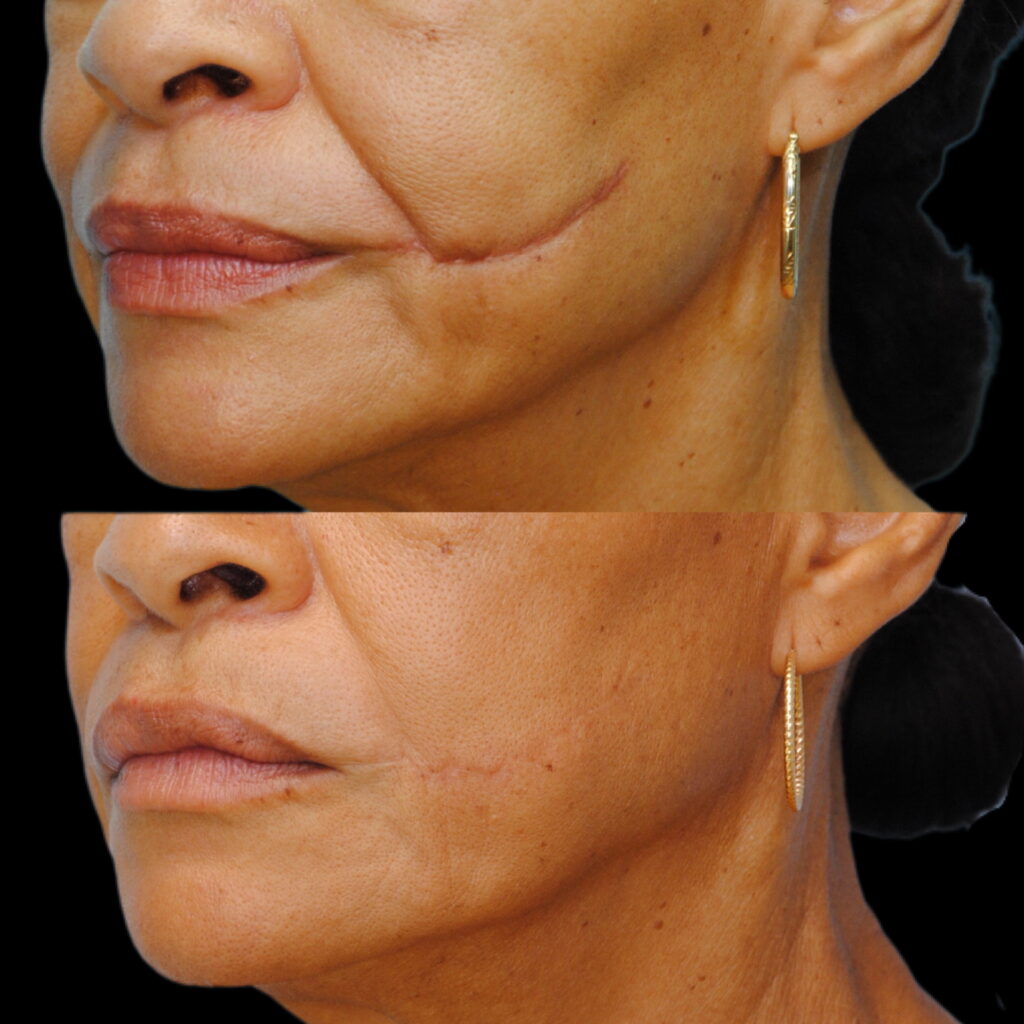
Scar revision surgery is a highly specialized blend of advanced tissue mechanics and fine artistry to blend existing scar tissue seamlessly into the surrounding skin. Rather than erasing a mark entirely, our surgeons redirect tension lines, smooth raised textures, and refine thick boundaries to dramatically minimize visibility and restore natural movement. It is a precise process of structural remodeling, revising the past so your skin can move beautifully into the future.
Quick Facts
The Procedure
Scar revision surgery can improve the appearance, texture, and visibility of scars from injury, past surgeries, burns, or other trauma. While no treatment can completely erase a scar, these advanced surgical techniques can minimize its appearance by refining irregular contours, reducing discoloration, improving skin tension, and restoring a more natural-looking surface.
For surface-level irregularities, resurfacing techniques like certain chemical peels, microneedling, or CO2 laser resurfacing can polish away uneven textures layer by layer, encouraging fresh, healthy tissue to take its place. If the scar is severe, pulls against natural movement, or distorts adjacent structures, we’ll utilize geometric tissue rearrangements (called Z-plasty or W-plasty) to carefully redirect the scar along the skin’s natural tension lines, relieving structural stress and making the mark significantly less perceptible to the eye. Using specialized instruments and micro-suturing techniques, the skin edges are realigned with extreme precision so the new seam heals as a faint, flat, and beautifully integrated line.
Recovery
Following scar revision surgery, patients may experience mild swelling, redness, and tenderness as the area begins to heal. Recovery varies depending on the size and location of the scar, as well as the specific techniques used during treatment. As healing progresses, the revised scar will continue to mature and improve in appearance over the following weeks and months. It is normal for scars to appear pink or slightly firm during the early stages of recovery before gradually softening and fading. Consistent follow-up care, proper wound management, and sun protection play an important role in achieving the best possible outcome. With patience, you can expect a smoother, less noticeable scar that blends more naturally with the surrounding skin.
What to Expect on
Your First Visit
Your first visit includes a detailed assessment to map out the unique landscape of your scar. Dr Joseph will evaluate the scar’s texture, thickness, and elasticity, while examining how it interacts with your skin’s natural tension lines and movement. Together, we’ll discuss the timeline of the original injury, explore revision strategies for your tissue type, and establish realistic expectations for your final result. This is a collaborative process to address concerns, answer questions, and educate the patient about the entire surgical process through recovery.
Frequently Asked Questions
While it would be wonderful to erase a scar entirely, the true goal of revision surgery is minimization rather than total erasure. Think of it as a structural reconfiguration: we alter the landscape of the scar, changing its direction, smoothing its texture, and narrowing its boundaries. With this procedure, we can make the scar blend so seamlessly into your skin’s natural contours that it becomes difficult to detect.
Every scar has its own unique geography, which requires a highly personalized evaluation. During your assessment, your surgeon evaluate whether the scar is raised (hypertrophic), sunken (atrophic), or tightly pulling against your skin’s movement (a contracture). Raised or uneven scars often benefit from advanced resurfacing techniques to smooth the texture. Depressed scars may require precise grafting or dermal fillers to lift, while restrictive scars are corrected using geometric tissue rearrangements to redirect the tension lines and restore freedom of movement.
Patience plays a massive role in the art of scar revision. A scar continues to mature, change color, and remodel its internal structure for a full twelve months after an injury. Operating too early on a newly healed scar can actually trigger more inflammation. In most cases, it is best to let the tissue settle and mature for at least a year before we can refine and reshape the framework.
Comfort and precision are built into every step of the procedure. Depending on the size and location of the scar, the revision can often be performed comfortably right in the office using local anesthesia. For larger or more complex structural revisions, light sedation or twilight anesthesia keeps patients completely relaxed. The experience is straightforward and the process is designed to keep patients comfortable from start to finish.
The immediate post-op period is all about giving your skin the right environment to heal. Patients can expect mild swelling and redness around the new, refined incision during the first week. We close the revised skin edges using delicate, hair-thin micro-sutures, which are typically removed within five to seven days. While the initial healing happens quickly, the new line will continue to fade and soften over the coming months as the fresh tissue integrates into your surrounding skin. Most patients see full results within 12 months after the procedure.
Technically, any surgical incision creates a scar, but the critical difference lies in the method of closure. The original scar was likely the result of sudden trauma, uneven tension, or poor healing conditions. Revision surgery replaces that jagged, wide, or raised tissue with a surgically optimized, less noticeable scar. By eliminating tension and placing hair-thin stitches, the new line heals flat, narrow, and exceptionally faint.
Long-term success relies heavily on post-op care. The golden rule of scar revision recovery is strict sun protection. New, healing tissue is highly sensitive to UV rays, which can cause permanent hyperpigmentation and make the line turn dark or muddy. Keeping the area covered, utilizing specialized medical-grade silicone sheets or gels as directed, and consistently applying broad-spectrum sunscreen will keep the new seam flat, bright, and blended.