Elegance At Every Angle
Because your nose sits at the very center of your face, even the smallest imbalance can throw your entire profile out of proportion. But, even a beautiful nose may not function perfectly. Drawing on our deep expertise in ENT medicine, we approach every rhinoplasty from the inside out. Dr. Jospeh can sculpt a refined, natural-looking silhouette that complements your unique facial character while simultaneously optimizing your airway for clear, effortless breathing. Our goal is never to give you someone else’s nose, but to sculpt the much-improved, high-functioning centerpiece for your own face.
Quick Facts
The Procedure
Depending on your goals, we’ll use either a closed rhinoplasty, where all incisions are entirely inside the nostrils, or an open rhinoplasty. For an open procedure, we make a tiny, stepped incision across the columella, the narrow strip of tissue separating your nostrils. This small incision is meticulously placed, allowing us to gain direct visual access to the underlying cartilage and bone structure.
To reshape a prominent bridge, the surgeon shaves down excess bone or cartilage to create a smoother, more elegant profile. Suturing and grafting techniques help to refine, lift, or rotate the tip to fix excessive width or drooping without compromising structural support. At the same time, any internal blockages are corrected, so your newly sculpted nose breathes even better than before. Once this refinement is complete, the skin is gently draped back over its new framework, internal incisions are closed, and external incisions are secured with hair-thin, dissolvable stitches. Finally, a custom external splint is placed over the bridge and a small amount of packing or flexible silicone intranasal splints are placed to protect your new profile.
Recovery
The recovery following a rhinoplasty is a steady, progressive journey that requires patience and gentle care. For the first week, your external splint and internal silicone splints will remain in place to protect your newly sculpted profile and support your airway. Patients may experience some nasal congestion, mild swelling, and light bruising around the eyes, which naturally peaks within the first seventy-two hours. By the end of the first week, we’ll gently remove all splints and sutures in our office, revealing the first look at your refined nose. While the majority of the swelling will resolve over the next three months, the remaining fine swelling will subtly dissipate over the next year, gradually revealing your nose’s final, beautifully defined, and high-functioning contour.
What to Expect on
Your First Visit
Your initial consultation is a blueprinting session. During this first visit, we’ll discuss your medical history, evaluate your external nasal anatomy, and assess your internal airway structures. Using high-resolution digital imaging, we’ll examine your unique facial proportions, so you an visualize potential outcomes and explore how different refinements work with your other features. During the consultation, we encourage you to ask questions, discuss the structural techniques involved, and help design your surgical plan.
Frequently Asked Questions
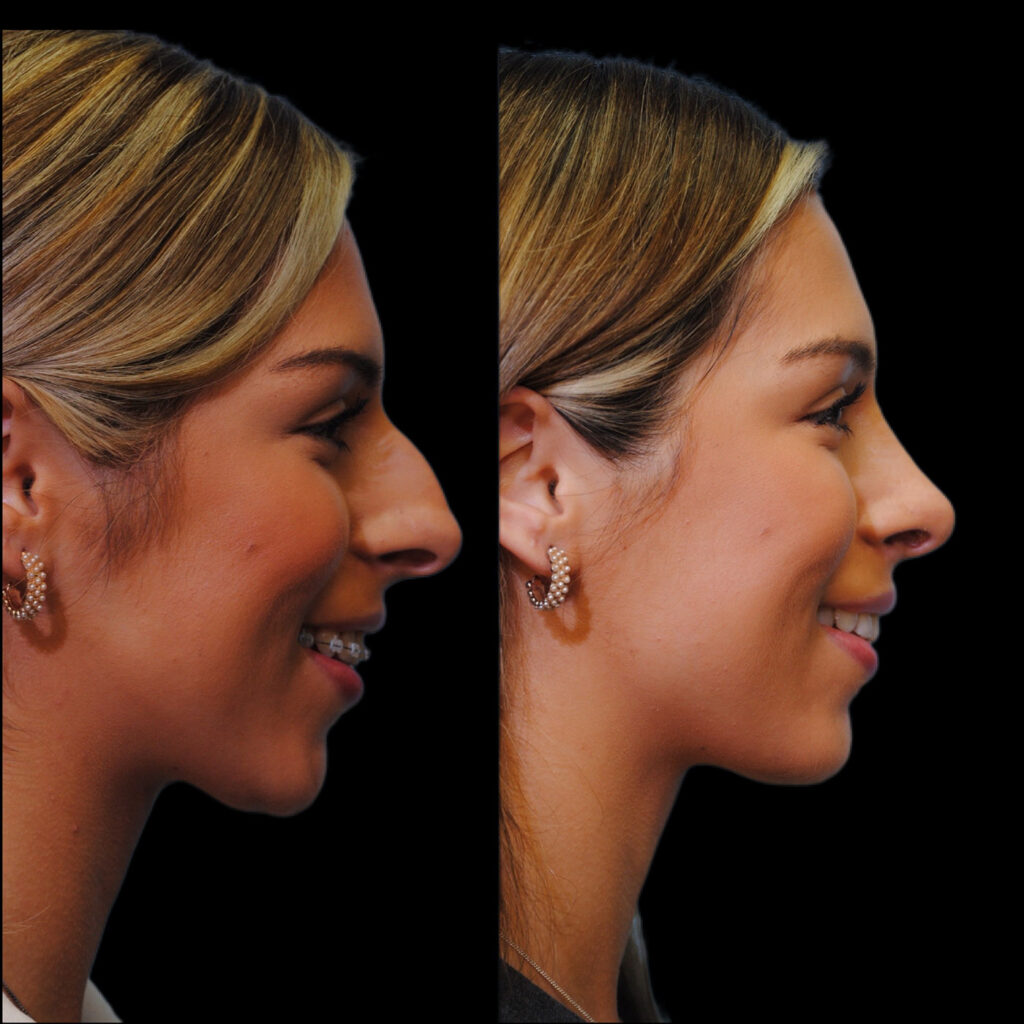
Every face has its own natural geometry and proportions, but a successful rhinoplasty considers your entire facial structure, including the projection of your chin, the angle of your forehead, and your specific ethnic heritage. The goal is to create a refined, elegant nose that looks completely natural and blends with your existing features, enhancing your overall balance rather than looking “operated on.”
Form and function are inseparable when it comes to nasal surgery. If you struggle with a deviated septum, chronic congestion, or enlarged turbinates, these internal structural blockages are corrected during the procedure. By combining aesthetic reshaping with structural repairs like a septoplasty, the airway is cleared, ensuring that your newly sculpted nose breathes even better than it looks.
The initial recovery phase is focused on protection and structural support. You’ll wear a custom external splint on the bridge of your nose and soft-coated packing and possibly flexible silicone internal splints inside the nasal passages. While you may experience some swelling and mild bruising around the eyes, actual physical discomfort is typically very manageable and well-controlled with standard medication.
Patience is an important part of the healing process. While major swelling subsides within the first three months, the final refinements take time. The nasal skin must slowly heal over the new, sculpted cartilaginous framework. Residual swelling, especially at the tip, resolves gradually over a full twelve-month period, which is when the newly shaped definition is truly revealed.
Minimizing visible signs of surgery is a top priority. For a closed rhinoplasty, there is zero external scarring because all work is performed through internal channels. For an open rhinoplasty, the tiny incision under the nose is closed with hair-thin stitches. Once fully healed, this mark typically fades into a faint, nearly imperceptible line hidden within the natural contour of the nasal base.
Safety is built into every layer of the surgical plan, starting with a comprehensive pre-operative health assessment. The procedure is performed in a fully accredited surgical suite with advanced anesthesia protocols for a smooth entry and exit from sleep.
To prepare yourself for surgery, we recommend stopping certain supplements and medications that can increase bleeding, staying hydrated, and avoiding nicotine and direct sun exposure. At home, setting up a dedicated recovery space with a comfortable wedge pillow to keep your head elevated, having ice packs ready to manage initial swelling, and arranging for a trusted companion to drive you home will allow you to focus entirely on resting. During your consultation, we’ll cover all pre-op and post-op recovery guidelines so you have a clear picture of what to expect before, during, and after surgery.